

Navigating the complexities of a multi-step skincare regimen often leads to confusion regarding product application sequence. If you have ever stared at your vanity wondering, “do you apply serum or moisturizer first,” you are certainly not alone. The general rule of thumb in dermatology and professional esthetics is to apply products from the thinnest consistency to the thickest.
Because serums are typically lightweight, water-based formulations packed with concentrated active ingredients, they should almost always be applied before your heavier, cream-based moisturizer. This layering strategy ensures that the potent ingredients reach the deeper layers of the epidermis without being blocked by the occlusive properties of a thicker cream.
Understanding Molecular Weight and Absorption

The primary reason for the standard skincare routine order lies in the physics of product absorption. Science dictates that formulas with a lower molecular weight are designed to penetrate the skin barrier more effectively than larger, more complex molecules. Serums are engineered to be lightweight, often containing smaller molecules that can bypass the surface to deliver targeted benefits, such as brightening or cellular repair.
If you were to apply a heavy moisturizer first, you would essentially be creating a physical barrier on the surface of your skin. This barrier would prevent the serum from being absorbed, rendering those expensive active ingredients ineffective.
By applying your serum on clean, slightly damp skin, you allow the active molecules to latch onto the skin cells immediately. Once these ingredients have had a moment to settle, you can follow up with a moisturizer. Moisturizers are generally formulated with larger molecules and thicker textures to provide a protective seal.
They act as a topcoat, locking in the hydration provided by the serum and preventing transepidermal water loss. Understanding this relationship between texture, molecular size, and penetration is the foundation of an effective regimen. When you respect this order, you are not just applying products; you are creating a synergistic environment where each layer supports the one beneath it.
The Role of Humectants and Occlusives
To master the art of layering, it is essential to distinguish between the roles of different skincare components. Many serums rely heavily on humectants, such as hyaluronic acid or glycerin. These ingredients function like magnets, drawing moisture from the environment or deeper skin layers to the surface of your skin.
However, humectants can sometimes have the opposite effect if the air is extremely dry, pulling moisture out of the skin rather than into it. This is where your moisturizer comes in. Moisturizers often contain occlusives and emollients that sit on the surface to seal that moisture in.
If you apply an occlusive moisturizer before a humectant-rich serum, the serum cannot effectively draw moisture in, nor can it penetrate the barrier created by the cream. By placing the serum first, you utilize the humectants to hydrate the skin, and then you follow with the occlusive moisturizer to create a “lid” over those ingredients.
This prevents evaporation and keeps your skin feeling plump and hydrated throughout the day. This chemical interplay is why the “thinnest to thickest” rule is more than just a preference; it is a functional necessity for maintaining a healthy skin barrier and preventing dryness or irritation.
Categorizing Your Products by Texture
Visualizing your products based on their physical properties can help eliminate the “do you apply serum or moisturizer first” dilemma once and for all. Think of your routine as a tiered system where the weight of the product determines its placement. Typically, your sequence should look like this: cleanser, toner, treatment serum, then moisturizer.
Serums are almost always water-based serums, which have a fluid, easily absorbed texture. Moisturizers, by contrast, are emulsions of oil and water, often thicker and designed to provide a protective, softening effect on the skin’s surface.
The Layering Hierarchy
- Cleanser: Removes debris and prepares the canvas.
- Toner: Balances skin pH and removes residual impurities.
- Treatment Serum: Delivers concentrated actives like vitamin c, retinol, or niacinamide.
- Moisturizer: Provides hydration and seals in previous layers.
- Sunscreen: The final, essential layer to protect against UV damage.
By following this structure, you ensure that every product has the maximum opportunity to work. If you have multiple serums, apply them from the most liquid to the slightly more viscous, always waiting a few seconds between applications to allow for proper absorption. This methodical approach prevents the “pilling” effect, where products clump up on the skin because they were applied in a way that didn’t allow for proper setting.
Handling Active Ingredients and Sensitivity
The order of application becomes even more critical when you are working with high-potency active ingredients. Ingredients like vitamin c, retinol, and chemical exfoliants are designed to alter skin function, and their efficacy is highly dependent on direct contact with the skin.
If you apply a moisturizer before your retinol serum, you might dilute the concentration or hinder the delivery of the molecule into the follicle. While some people with sensitive skin intentionally apply moisturizer first to “buffer” the retinol and reduce irritation, this is a specific technique for tolerance building rather than the standard approach for optimal results.
When dealing with potent actives, consider the pH level of your skin. Many acids and vitamin C derivatives require a specific, acidic skin pH to function properly. Applying a heavy, pH-neutral or alkaline moisturizer before these actives can shift the skin’s environment, potentially deactivating the serum’s potency.
Therefore, for the best results, apply your treatment serums directly to cleansed skin. If you find that a product is too strong, look for a lower concentration rather than relying on a moisturizer layer to block its efficacy. This ensures you get the clinical benefits you are paying for while maintaining the integrity of your routine.
Comparing Product Types
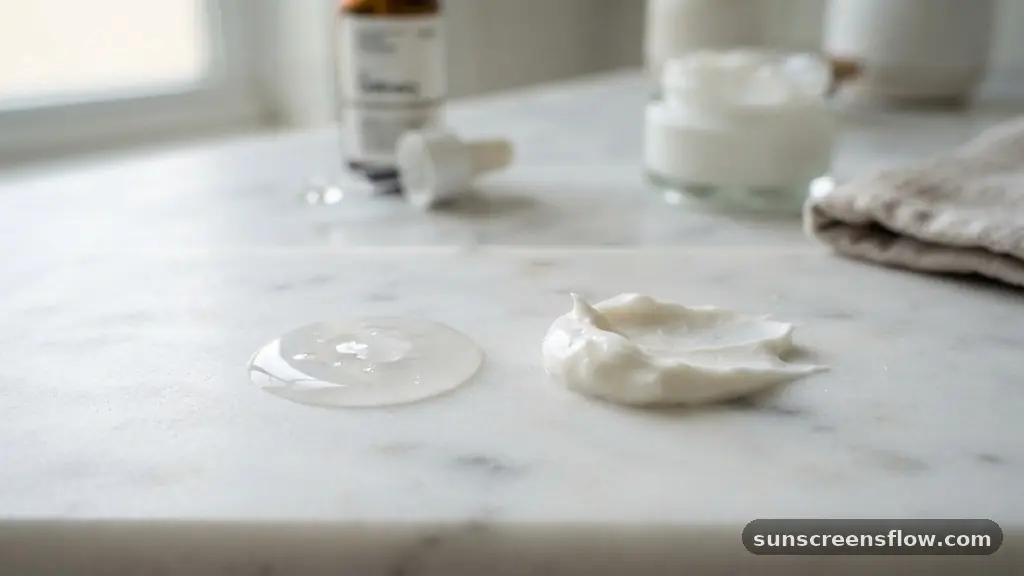
Not all products fall neatly into the “serum” or “moisturizer” bucket, which can cause confusion. Some modern formulations, such as gel-creams or hybrid emulsions, blur the lines. When in doubt, consult the viscosity.
If the product is transparent and runny, it is likely a serum. If it is opaque and creamy, it is likely a moisturizer. The following table illustrates how different product categories generally compare in terms of their primary function and their position in your daily routine.
| Product Category | Primary Function | Typical Position |
|---|---|---|
| Toner | Balance & Hydration | After Cleansing |
| Water-Based Serum | Targeted Treatment | After Toner |
| Oil-Based Products | Sealing & Nourishing | After Moisturizer |
| Moisturizer | Barrier Protection | Before Sunscreen |
As shown in the table, oil-based products are a special case. Because oil is denser than water and can penetrate many creams, it is often best applied as the final step in your evening routine.
While some lightweight oils can be mixed with moisturizer, applying them on top of your cream ensures they don’t block the absorption of water-based serums. Always adjust your routine based on the specific needs of your skin type, whether you are managing dry skin, oily skin, or combination skin.
Addressing Common Topical Gaps
Many people struggle with the application order because they don’t understand how to handle “in-between” products like facial oils or targeted spot treatments. A common gap in knowledge is whether spot treatments for acne go before or after moisturizer. Generally, acne treatments should be applied directly to the affected area after cleansing.
If you apply a moisturizer over the entire face, try to avoid the specific spot-treated area, or wait for the treatment to dry completely before applying the cream. This prevents the active ingredients from migrating to unaffected skin, which can cause unnecessary dryness.
Another gap is the timing of application. Should you wait for the serum to dry completely? While you don’t need to wait until your skin feels “tight,” giving your serum about 60 seconds to absorb is beneficial.
This allows the water content to evaporate slightly and the active molecules to anchor themselves. If you apply your moisturizer immediately while the skin is still very wet from a watery serum, the cream might slide around and fail to create an even, protective film. Finding that “sweet spot” of damp-but-not-dripping skin is key to an effective, efficient skincare routine that yields visible results over time.
Navigating Skin Type Considerations
Your specific skin type should influence how you interpret the order of application. Those with oily skin may find that they can skip a heavy moisturizer entirely, opting instead for a hydrating serum and a lightweight, non-comedogenic lotion. If you have oily skin, your primary concern is often pore clogging.
Heavy, occlusive creams can sometimes trap sebum and bacteria, leading to breakouts. By focusing on water-based serums that provide hydration without heavy oils, you can keep your skin balanced without feeling greasy.
Conversely, those with dry skin often need a multi-layered approach. You might find that a single serum and moisturizer combination isn’t enough. In this case, you can layer a humectant-based serum (like hyaluronic acid), followed by a nourishing cream, and finished with a few drops of a facial oil.
This layering helps address the lack of natural lipids in dry skin and provides a long-lasting barrier that keeps the skin comfortable throughout the day. Always prioritize products labeled as non-comedogenic to ensure that even with multiple layers, you aren’t inadvertently causing congestion or acne.
The Role of Sunscreen in Your Routine
Regardless of whether you use a complex serum or a simple moisturizer, sunscreen is the one product that must always be applied last in your morning routine. Sunscreen is designed to sit on the surface of the skin to create a physical or chemical shield against UV rays.
If you apply a moisturizer or a facial oil on top of your sunscreen, you risk diluting it, moving it around, or creating a film that is less effective at blocking radiation. This is a common mistake that can significantly reduce the level of protection you receive.
Always allow your moisturizer to fully absorb before applying sunscreen. If you use a chemical sunscreen, it needs direct contact with the skin to react properly with UV light. If you use a mineral sunscreen, it needs to form an even, opaque layer on the surface.
By waiting a few minutes after your moisturizer application, you ensure that the sunscreen remains undisturbed and can provide the full SPF rating indicated on the bottle. Think of your serum and moisturizer as the “skin prep” phase and your sunscreen as the “protection” phase. They serve two completely different purposes and should never be intermingled in a way that compromises the efficacy of your sun protection.
Consistency and Long-Term Skin Health
Ultimately, the goal of understanding the order of application is to achieve long-term skin health through consistency. Skincare is a cumulative process, not an overnight miracle. By sticking to a logical order—cleansing, treating with serums, moisturizing, and protecting—you allow your skin to function at its best.
If you find yourself overwhelmed by a ten-step routine, remember that you can simplify it without sacrificing results. A high-quality serum and a reliable moisturizer are often all you need to maintain a healthy barrier and address specific concerns like hyperpigmentation or dehydration.
Don’t be afraid to experiment with the timing of your routine to see what works best for your lifestyle. If you are in a rush, focus on the essentials: a gentle cleanser, a versatile serum, a moisturizer, and sunscreen. As you become more comfortable with how your skin reacts to these products, you can introduce more targeted treatments.
Remember that the “thinnest to thickest” rule is a reliable guide, but your skin’s unique response is the final authority. If a particular order leaves your skin feeling irritated, too dry, or overly greasy, adjust accordingly. Your routine should be a source of confidence and care, not a source of stress.
Frequently Asked Questions
Can I mix my serum and moisturizer together in my palm?
While it is tempting to mix them to save time, it is generally better to apply them separately. Mixing them can alter the pH and the delivery system of the serum, potentially making the active ingredients less effective or causing the moisturizer to lose its occlusive properties.
What if I use a toner in my routine?
Toner should always be applied after cleansing and before your serum. It helps to remove any remaining impurities and prepares the skin to better absorb the active ingredients in your serum. Think of it as the transition step that resets your skin’s pH after washing.
Does the order change at night versus in the morning?
The fundamental order remains the same: thinnest to thickest. However, you can omit sunscreen at night and instead incorporate heavier, more nourishing products like facial oils or sleeping masks. The goal at night is repair and deep hydration, whereas the morning goal is treatment and protection.
Is it possible to use too many serums?
Yes, using too many serums can lead to product pilling and potential irritation. It is usually best to stick to two or three targeted serums at most. Applying more than that can overwhelm the skin, making it difficult for any of the active ingredients to penetrate effectively.
Conclusion
The question of “do you apply serum or moisturizer first” is a fundamental query for anyone looking to optimize their skincare results. By adhering to the principle of applying products from the thinnest to the thickest consistency, you ensure that your serums can effectively penetrate the skin, while your moisturizer acts as a vital seal to lock in hydration and support your skin barrier. Remember that serums are your targeted workhorses, designed to deliver potent active ingredients, while moisturizers are the guardians of your skin’s surface, preventing moisture loss and providing essential lipids.
Whether you are addressing concerns like dry skin or simply maintaining a healthy complexion, the order of your routine matters. By following the guidelines outlined here—respecting molecular weights, prioritizing absorption, and always finishing with sunscreen—you can build a regimen that is not only effective but also sustainable for your skin’s long-term health. Consistency, combined with a logical layering approach, is the definitive path to achieving your skincare goals.


