

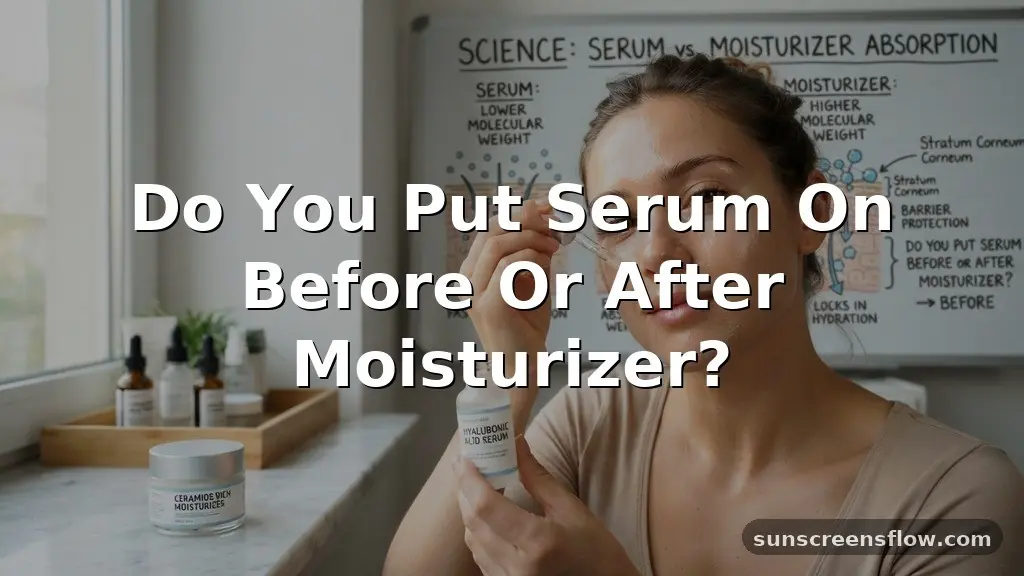
Deciphering the correct order of your skincare products is one of the most common hurdles for beauty enthusiasts. If you have ever stared at your vanity wondering, do you put serum on before or after moisturizer, you are certainly not alone. The simple answer is that you should almost always apply your serum before your moisturizer.
This rule of thumb is rooted in the fundamental principles of cosmetic chemistry, specifically regarding product viscosity and molecular weight. By understanding how these layers interact with your skin, you can ensure that your potent treatments are actually doing the work they were designed to do, rather than sitting uselessly on the surface of your face.
The Science of Absorption and Molecular Weight
To understand why sequence matters, we must first look at how the skin absorbs topical applications. Your epidermis acts as a sophisticated barrier, designed to keep external pathogens out while retaining internal moisture.
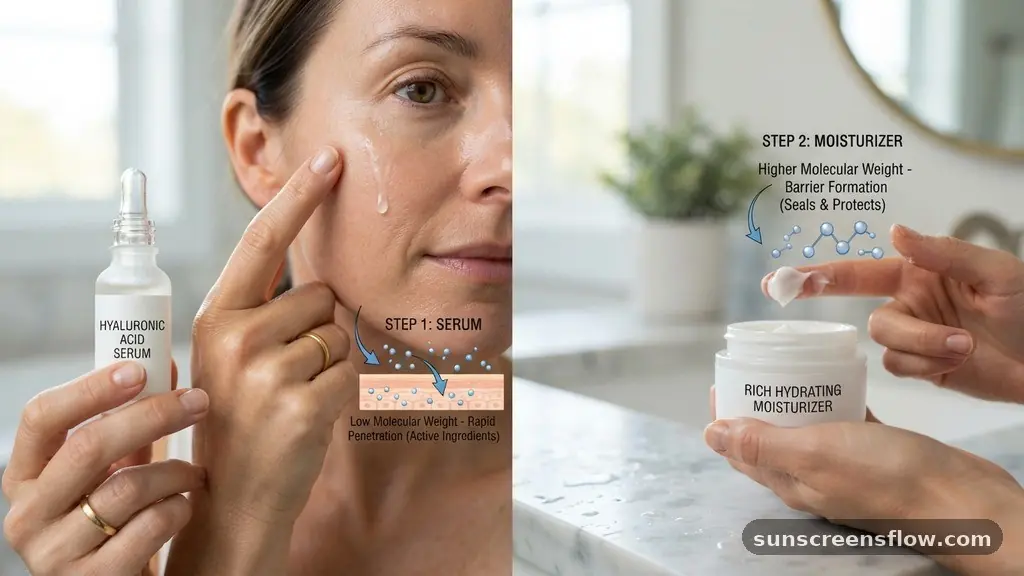
When you apply products, their ability to reach the deeper layers of the skin depends heavily on their formulation. Serums are typically engineered with a lower molecular weight, meaning the particles are smaller and can penetrate the skin more effectively.
Conversely, moisturizers are formulated with larger molecules and thicker consistencies. They are designed to sit on top of the skin to trap hydration and prevent trans-epidermal water loss. If you were to apply a heavy moisturizer first, you would essentially be creating a physical seal over your skin.
If you then applied a serum on top, the active ingredients would struggle to bypass the heavy, occlusive barrier of the cream, resulting in poor absorption rate and wasted product. By applying your serum first, you allow those small-molecule actives to reach the target area of the skin before you lock them in with the protective layer of your moisturizer.
Understanding the Role of Product Viscosity
In the world of skincare, the general rule is to apply products from the thinnest consistency to the thickest. This is often referred to as layering by product viscosity.
A water-based serum is usually thin, runny, and lightweight, making it the perfect candidate for the first step after cleansing and toning. If you apply a thick, creamy moisturizer first, its density prevents the thinner serum from ever reaching the skin.
Think of it like a sponge: if you coat a sponge in a thick layer of wax, it becomes impossible for water to soak through. Your skin works in a similar, albeit more complex, way. By following the texture-based layering method, you ensure that every product has a fair chance to interact with your skin cells.
This isn’t just about efficiency; it is about respecting the integrity of your skin barrier. When products are applied in the correct order, they work in harmony rather than competing for space or blocking each other’s pathways to the dermis.
The Protective Function of Moisturizers
While serums are the “workhorses” of a skincare routine, focusing on specific concerns like hyperpigmentation or fine lines, the moisturizer is the “guardian.” Most moisturizers contain emollient properties that soften the skin and occlusive ingredients that act as a physical shield. These ingredients, such as ceramides, shea butter, or petrolatum, are essential for maintaining a healthy pH balance and preventing the environment from stripping moisture away from your face.
If you apply a moisturizer before a serum, you are essentially asking a serum to fight through a wall of lipids. Even if the serum is highly potent, the occlusive nature of the moisturizer will blunt its effectiveness.
By reversing the order—applying your serum to clean, dry, or slightly damp skin—you ensure that the active ingredients like vitamin C, retinol, or peptides can do their job. Once they have been given a moment to sink in, the moisturizer then acts as a lid, sealing those benefits inside and protecting the skin from external stressors throughout the day or night.
Navigating Ingredient Compatibility
When layering products, it is not just about the order of application; it is also about understanding how ingredients play together. For instance, a water-based serum containing hyaluronic acid works as a humectant, drawing moisture from the environment into the skin. If you apply this on top of a heavy, oil-based moisturizer, the serum might not be able to pull in the necessary moisture, or worse, it might cause the moisturizer to pill or flake.
Furthermore, some active ingredients require specific environmental conditions to function. Retinol, for example, is highly effective but can be irritating if the skin barrier is compromised. Applying a light, hydrating serum before or after a retinol treatment—depending on your skin’s sensitivity—can help buffer the intensity of the treatment.
However, the golden rule remains: if you are using a standard treatment serum, apply it as close to the skin as possible to maximize penetration. Always check for non-comedogenic labels if you are prone to pore clogging, as layering too many heavy products can lead to breakouts regardless of the order you choose.
Comparing Skincare Layers
To help visualize how different products interact with your skin, the following table summarizes the typical characteristics and placement of various skincare items in your daily routine.
| Product Type | Primary Function | Consistency | Layering Order |
|---|---|---|---|
| Cleanser | Removal of impurities | Liquid/Gel/Cream | 1st (Always) |
| Serum | Targeted treatment | Thin/Watery | 2nd |
| Moisturizer | Hydration & Sealing | Cream/Lotion | 3rd |
| Facial Oil | Sealant/Nourishment | Oil | Final Step |
This table illustrates that as you move down the list, the products become thicker and more occlusive. Following this sequence ensures that you aren’t just applying products, but strategically building a regimen that supports your skin texture and long-term health.
Common Mistakes in Skincare Layering
One of the most frequent mistakes people make is applying their products too quickly, one right after the other. Even if you get the order correct—serum then moisturizer—if you don’t give the serum time to absorb, you will simply smear it around when you apply your cream. This can lead to a messy application and can actually reduce the efficacy of your topical application.
Another common error is applying too many serums at once. While it might be tempting to use a vitamin C serum, a hyaluronic acid serum, and a niacinamide serum all in one go, this can overwhelm your skin and lead to irritation. Instead, focus on a streamlined routine.
A good rule of thumb is to wait 30 to 60 seconds between layers. This gives the active ingredients enough time to sink into the epidermis.
If you feel that your skin is still tacky or wet, wait a little longer before applying your moisturizer. Patience in your routine is just as important as the products themselves.
When Exceptions to the Rule Apply
Are there ever times when you should break the rule? Occasionally, yes. If you are using a very thick, specialized treatment serum or if your skin is extremely sensitive, some dermatologists may suggest applying a very thin layer of moisturizer first to act as a buffer.
This is common when introducing potent ingredients like prescription-strength retinoids to the skin. By creating a “sandwich” effect—moisturizer, then treatment, then moisturizer—you can mitigate the risk of irritation while still allowing the treatment to penetrate.
However, for 95% of users and products, the traditional order—serum before moisturizer—is the gold standard. If you are ever unsure, check the packaging of the specific product.
Brands often provide instructions on the back of the bottle that specify whether the product should be used on clean, dry skin or as a treatment step within a larger routine. When in doubt, follow the “thinnest to thickest” principle, as it is the most reliable guide for ensuring your products perform as intended.
The Impact on Long-Term Skin Health
Consistently applying your products in the correct order does more than just make your routine feel organized; it directly impacts the health and appearance of your skin over time. When you properly layer your skincare, you are supporting the skin barrier, which is your first line of defense against pollution, UV rays, and dehydration. A well-hydrated, well-nourished barrier is more resilient, leading to a smoother skin texture and a more radiant complexion.
Furthermore, correct layering prevents the waste of expensive products. If you apply a luxury serum on top of a thick cream, you are essentially paying for ingredients that will never reach your skin cells.
By ensuring that these high-performance ingredients have a direct path, you get more value out of your investment. Over time, this disciplined approach leads to better results, whether your goal is to brighten, hydrate, or fight the signs of aging.
Frequently Asked Questions
Does it matter if I use a facial oil instead of a moisturizer?
Yes, it matters significantly. A facial oil is generally the final step in a routine because it is highly occlusive. Even if you use an oil, it should still be applied after your serum. Serums are water-based, and oils are lipids; the serum must go on first to penetrate the skin.
Can I mix my serum and moisturizer together to save time?
While you can mix them, it is generally not recommended. Mixing products can alter their pH balance and absorption rate. It is much better to apply them as distinct layers to ensure that each product can function at its maximum potential without interfering with the other’s chemical stability.
What if my serum is oil-based?
If your serum is oil-based, it should still be applied before a heavy cream moisturizer. However, if your moisturizer is very lightweight or gel-based, the order might be less critical. Always aim to apply the product with the smallest molecular structure first, regardless of whether it is water or oil-based.
How long should I wait between applying serum and moisturizer?
A good rule of thumb is to wait about 30 to 60 seconds, or until the serum feels mostly dry or tacky to the touch. This short wait time allows the product to absorb into the epidermis, ensuring it isn’t simply wiped away or diluted by the moisturizer that follows.
Conclusion
Mastering the sequence of your skincare routine is a simple but transformative habit. By consistently applying your serum before your moisturizer, you honor the science of product viscosity and molecular weight, allowing your active ingredients to do the heavy lifting they were formulated for. Whether you are using a water-based serum for hydration or a targeted treatment for specific concerns, remember that the goal is to provide a clear path to the skin.
By layering from thin to thick and allowing each product time to absorb, you protect your skin barrier, prevent trans-epidermal water loss, and ultimately achieve a healthier, more vibrant complexion. Stick to this order, be patient with your application, and your skin will undoubtedly thank you with improved texture and lasting health.


