


Deciding whether to incorporate a vitamin c serum morning or night is one of the most common dilemmas in modern skincare. Because this potent ingredient is celebrated for its ability to brighten the complexion and defend against environmental stressors, users often feel pressured to include it in their regimen without knowing the optimal time for application.
While many enthusiasts lean toward morning use to leverage its protective capabilities, others argue that nighttime application allows for deeper penetration during the body’s natural repair cycle. Understanding the biochemical properties of L-ascorbic acid and how it interacts with your daytime skincare routine versus your nighttime repair process is essential for achieving the best results.
The Scientific Case for Morning Application

When you choose to apply your serum in the morning, you are primarily utilizing its antioxidant properties to shield your skin from the external environment. Throughout the day, your skin is subjected to invisible threats, including pollution, smoke, and infrared radiation.
These elements contribute to the formation of unstable molecules known as free radicals. When these molecules strike the skin, they trigger free radical damage, which can lead to premature aging, fine lines, and a dull, uneven skin tone.
By applying a high-quality serum in the morning, you provide your skin with a reservoir of antioxidants that neutralize these unstable molecules before they can cause oxidative stress. This is often described as a secondary layer of defense.
While it is never a replacement for broad-spectrum sunscreen, the use of this serum significantly enhances your UV protection. Research consistently suggests that when antioxidants are applied topically, they help mitigate the impact of incidental sun exposure, which is particularly beneficial for those living in urban environments or areas with high pollution levels.
Why Nighttime Application Is Often Recommended
If you prefer a nighttime repair approach, you are focusing on the biological synergy between active ingredients and the skin’s natural circadian rhythm. During the night, your skin transitions from a defensive state to a state of regeneration.
This is when the skin’s metabolic rate is at its highest, allowing for the repair of cellular damage accumulated during the day. Some dermatologists argue that applying your serum at night allows the product to work undisturbed by external pollutants, potentially increasing the efficiency of collagen production.
Furthermore, if your skin is prone to skin sensitivity, applying your treatment at night can be a strategic move. Many people find that their skin is less reactive in the evening, and by applying the serum before bed, you allow the active compounds to absorb fully without the interference of makeup or environmental grime. This method is especially popular for those who use products with a high serum concentration that might cause mild tingling or redness, as any potential irritation can subside while you sleep, leaving you with a refreshed appearance by morning.
Understanding L-Ascorbic Acid and Oxidation
The efficacy of your serum is heavily dependent on the stability of the formula. The most common form of vitamin C used in skincare is L-ascorbic acid, which is highly effective but notoriously unstable.
This molecule is sensitive to light, heat, and air. Oxidation occurs when the serum is exposed to these elements, turning the clear or pale-colored liquid into a yellowish or brownish hue. Once a serum has oxidized, it loses its potency and may even cause irritation due to the formation of degradation byproducts.
To maximize the shelf life of your product, you must be mindful of air exposure. Most reputable brands package their serums in opaque, airtight bottles to prevent this degradation. If you notice your serum changing color significantly, it is a sign that the antioxidant properties have been compromised.
Whether you choose to use it in the morning or at night, ensuring that the product is fresh is more important than the timing itself. If your bottle has been sitting on your vanity for over six months, the chemical structure may have already degraded, rendering the product ineffective regardless of when you apply it.
Synergy with Ferulic Acid and Vitamin E
You will often find that high-performance serums contain a combination of ferulic acid and vitamin E. This is not a marketing gimmick; it is a sophisticated chemical stabilization strategy.
L-ascorbic acid is difficult to stabilize on its own, but when combined with ferulic acid and vitamin E, the stability and efficacy of the formula increase significantly. These three ingredients work in tandem to create a powerful antioxidant network that is far more effective than any single ingredient on its own.
In a daytime skincare routine, this trio provides an exceptional defense against photodamage. Ferulic acid, in particular, acts as a stabilizer that helps the vitamin C penetrate the skin barrier more effectively. By choosing a formula that features this specific combination, you ensure that your skin receives the maximum benefit of the active ingredients.
When shopping for these products, look for a concentration between 10% and 20%. Anything lower may not provide enough potency, while anything higher than 20% can often lead to unnecessary irritation without providing additional clinical benefits.
The Role of pH Level in Absorption
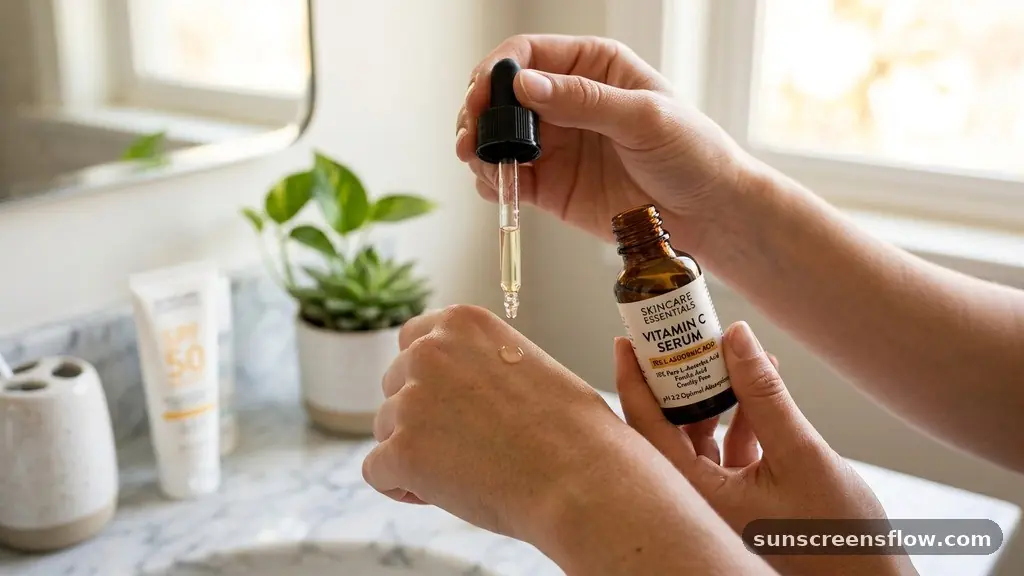
The pH level of your serum is a critical factor in how well it interacts with your skin. For L-ascorbic acid to be effective, the serum must be formulated at a low pH, typically below 3.5.
This acidity allows the vitamin C to penetrate the stratum corneum, the outermost layer of the skin. However, this low pH is also what can cause a stinging sensation for those with sensitive skin.
If you are using other products in your routine, such as chemical exfoliants (AHAs or BHAs) or retinoids, you need to be careful with the order of application. If you apply a high-pH product immediately after your serum, you may neutralize the acidity, rendering the vitamin C ineffective.
This is why many experts recommend waiting 10 to 15 minutes after applying your serum to allow it to fully absorb into the skin before layering on moisturizers or other treatments. By respecting the chemical environment required for the serum to work, you ensure that you are getting the most out of every drop.
Addressing Hyperpigmentation and Skin Texture
One of the primary reasons people seek out vitamin C is to treat hyperpigmentation and uneven skin texture. The ingredient works by inhibiting tyrosinase, an enzyme that is responsible for the production of melanin.
Regular, consistent use of a potent serum can help fade dark spots, sun spots, and post-inflammatory hyperpigmentation caused by acne. Because the process of skin cell turnover takes time, consistency is far more important than the time of day you choose to apply the product.
Whether it is in your morning or night routine, the key to seeing a visible improvement in your skin’s brightness is long-term adherence. It typically takes at least eight to twelve weeks of daily application to notice a significant difference in skin tone.
If you are struggling with stubborn dark spots, you might consider using a serum that contains additional brightening agents like kojic acid or niacinamide. These ingredients complement the brightening effects of vitamin C and help to address pigment issues from multiple angles, leading to a more radiant and even complexion over time.
Comparing Morning vs. Night: A Quick Reference
The following table outlines the primary considerations for choosing your application window, helping you decide which fits your lifestyle and skin goals best.
| Factor | Morning Application | Nighttime Application |
|---|---|---|
| Primary Goal | Environmental Protection | Deep Repair & Regeneration |
| Best For | Urban dwellers/High pollution | Sensitive skin/Complex routines |
| Key Benefit | Neutralizes free radicals | Boosts overnight recovery |
| Routine Priority | Layering with sunscreen | Layering with retinoids/moisturizer |
Common Mistakes to Avoid
Even the best products can fail if they are used incorrectly. One of the most common mistakes is failing to use sunscreen after your morning application.
Vitamin C is not a sunscreen, and it does not block UV rays; it only helps the skin manage the damage caused by the rays that do penetrate. If you skip SPF, you are essentially undoing the work the serum is trying to do.
Another mistake is improper storage. Because of the risk of oxidation, you should never store your serum in a bathroom that gets steamy or warm. Heat and humidity accelerate the breakdown of the active ingredients.
Keep your bottle in a cool, dark place, such as a drawer or a dedicated skincare fridge. Furthermore, avoid touching the dropper tip to your skin or any other surface, as this can introduce bacteria into the bottle, which may cause the formula to destabilize or become contaminated.
Integrating Into a Complex Routine
If you are already using other actives, such as retinoids or exfoliating acids, you might wonder how to fit a vitamin C serum into your daily life. The golden rule of skincare layering is to apply products from the thinnest consistency to the thickest. Typically, a serum is lightweight, meaning it should go on after cleansing and toning but before your heavier creams or oils.
- Cleanse your skin thoroughly to remove impurities.
- Apply a hydrating toner to balance the skin’s pH.
- Apply your vitamin C serum, allowing it to sink in for a few minutes.
- Follow with a moisturizer to lock in hydration.
- If it is daytime, finish with a broad-spectrum sunscreen.
- If it is nighttime, you may follow with a retinoid or an occlusive treatment.
By following this sequence, you ensure that each product has the best chance to perform its specific function without being blocked by heavier creams that might impede absorption.
Answering Frequently Asked Questions
Can I use vitamin C in the morning and at night?
While it is generally safe to apply twice daily, most dermatologists recommend once a day. Because the ingredient has a long half-life in the skin, applying it more frequently does not necessarily increase efficacy and may actually lead to irritation, especially if you have sensitive skin.
Does vitamin C make my skin more sensitive to the sun?
No, quite the opposite. Vitamin C is an antioxidant that helps defend the skin against the oxidative stress caused by sun exposure. It is not an exfoliant, so it does not increase your skin’s photosensitivity. However, always pair it with sunscreen to ensure full protection.
Can I mix vitamin C with retinol?
It is generally advised to keep these two separate. Retinol works best at a neutral pH, while vitamin C requires an acidic environment. Applying them together can reduce the effectiveness of both. Most users find success by using vitamin C in the morning and retinol in the evening.
How do I know if my serum has gone bad?
The most reliable indicator is a change in color. A high-quality serum should be clear or light champagne. If it turns dark orange or brown, it has oxidized and should be discarded. A slight yellow tint can sometimes be normal depending on the formulation, but a distinct darkening is a clear sign of degradation.
Final Thoughts on Routine Optimization
Ultimately, the choice between using a vitamin c serum morning or night comes down to your personal skin goals and how your skin reacts to the formula. If your primary concern is preventing daily environmental damage and maintaining a bright, even complexion, a morning application is likely your best bet. If you are more focused on intensive repair, collagen production, and avoiding potential irritation, a nighttime routine may suit you better.
Regardless of the time you choose, consistency is the most vital element. By selecting a stable, well-formulated product that contains complementary ingredients like ferulic acid and vitamin E, and by storing it properly to prevent oxidation, you are setting yourself up for success. Remember that skincare is a marathon, not a sprint.
Pay attention to how your skin feels and looks over several weeks, and don’t be afraid to adjust your routine as your skin’s needs change with the seasons or your lifestyle. By treating your skin with patience and high-quality ingredients, you will undoubtedly see the long-term benefits of this powerhouse antioxidant.